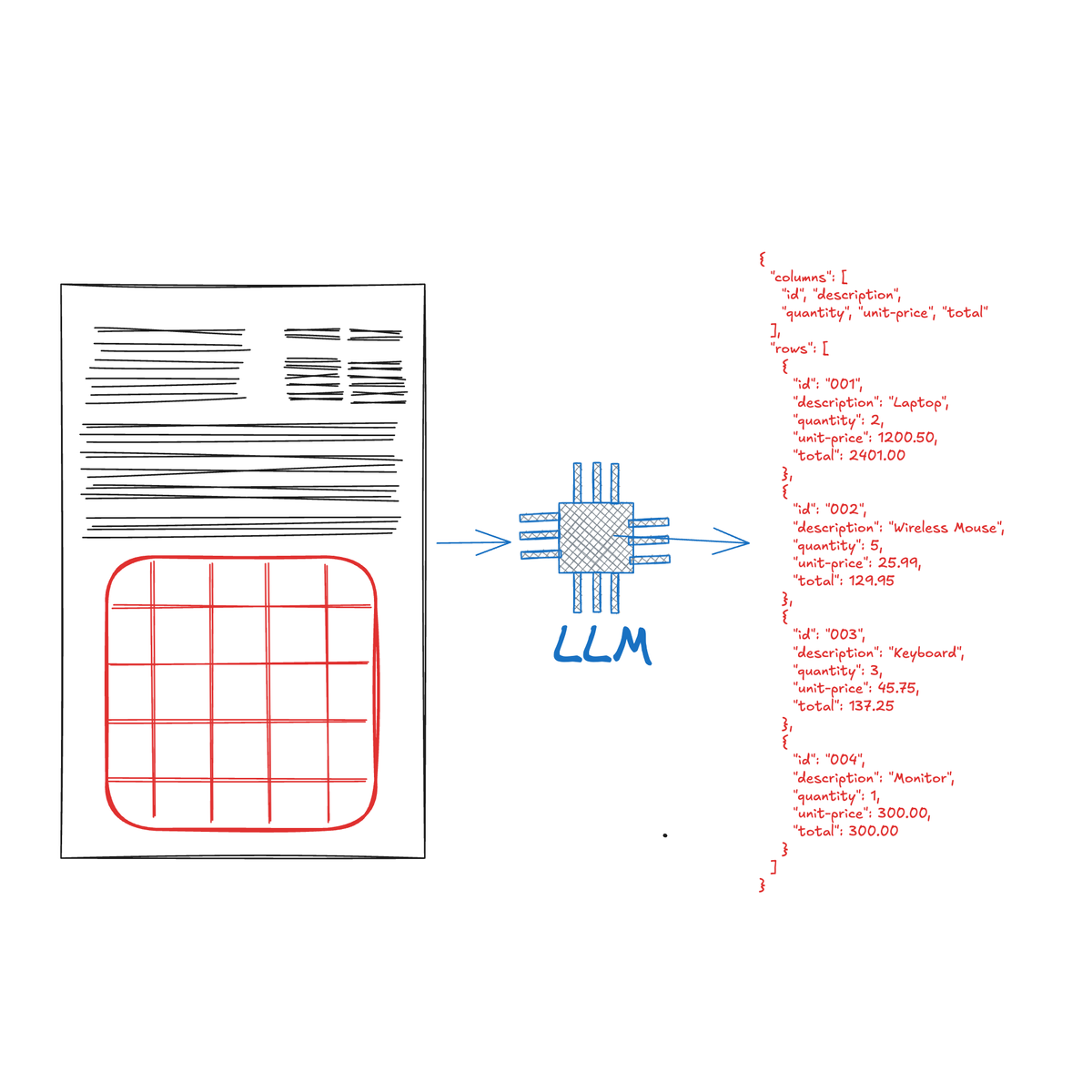
Unlock Structured Data for AI with Docling's Document Intelligence
In today's data-driven world, Artificial Intelligence (AI) holds the key to unprecedented innovation and efficiency. However, a significant barrier often stands in its way: unstructured documents. From dense PDFs and scanned images to complex contracts and research papers, the vast majority of enterprise data remains trapped in formats that AI systems struggle to interpret meaningfully. This is where
Docling steps in, transforming the chaotic landscape of "docs" into pristine, structured data, ready to power sophisticated AI applications.
Docling isn't just another OCR tool; it's a comprehensive document intelligence platform designed specifically to bridge the gap between human-readable documents and machine-consumable data. By intelligently deconstructing complex layouts and diverse content types, Docling enables AI to move beyond superficial text analysis to deep, contextual understanding. This deep understanding is crucial for everything from enhancing Retrieval Augmented Generation (RAG) systems to training more accurate machine learning models and automating intricate business processes. The future of AI relies heavily on the quality and structure of its input data, and Docling is engineered to deliver exactly that.
The Unseen Barrier: Why Unstructured Documents Hamper AI
Imagine an AI trying to make sense of a company's financial report, a legal brief, or a scientific journal. These documents are packed with critical information, but they are often presented in formats optimized for human eyes, not algorithms. They feature varying fonts, intricate tables, embedded images, mathematical formulas, and fragmented text spread across multiple pages. For AI, this presents a monumental challenge.
Traditional optical character recognition (OCR) can convert images of text into editable characters, but it often fails to preserve the *meaning* and *relationships* within the document. It might see "100,000" but won't know it's a revenue figure from a specific quarter, or that it relates to a particular product line in a table. This lack of inherent structure means that AI systems receive a flat, undifferentiated stream of text, missing vital contextual cues. This is a significant impediment for tasks requiring precision, such as data extraction, semantic search, intelligent summarization, and automated decision-making.
Furthermore, issues like page headers and footers, which are navigational aids for humans, become noise for AI if not properly identified and removed. Text fragmentation, where a single paragraph spans multiple columns or pages, breaks the flow of information, leading to disjointed interpretations. Without a sophisticated understanding of a document's layout and logical structure, AI systems will inevitably produce incomplete, inaccurate, or even misleading results. This is precisely the problem Docling was built to solve, providing a robust foundation for next-generation AI.
Docling's Blueprint for Structured Data: Beyond Basic OCR
Docling stands out by offering a holistic approach to document intelligence, going far beyond simple text extraction. It meticulously analyzes every component of a document, transforming it into a rich, structured representation that AI can readily consume and understand.
Intelligent Content Segmentation and Reading Order
One of Docling's foundational strengths lies in its ability to dissect a document into meaningful, bite-sized chunks of contiguous text. These components are then stored and traversed according to their natural reading order, a crucial feature that ensures AI maintains proper context. Unlike systems that merely process text from top-to-bottom or left-to-right, Docling understands the intended flow of information.
*
Contextual Fragmentation Management: Docling doesn't just recognize text; it understands how text relates. It accurately detects one or multiple bounding boxes per component, even when elements fragment and span across different pages. This is vital for maintaining the integrity of content, such as a paragraph that breaks across a column or page boundary. Docling intelligently concatenates these fragmented paragraphs, ensuring that AI receives complete and coherent textual units.
*
Noise Reduction and Precision: Page headers and footers, while necessary for human readability, often clutter AI's input. Docling intelligently detects these elements and offers the option to exclude them from exports, significantly improving the signal-to-noise ratio for AI processing. Similarly, it precisely distinguishes section headers from subsequent paragraphs, providing AI with a clear hierarchical understanding of the document's structure.
*
List Detection: Docling identifies and groups list items, presenting them in a structured format that helps AI understand enumerated or bulleted information more effectively. This ensures that the logical organization of lists is preserved, offering clearer data for summarization or extraction tasks.
Unlocking Tabular and Visual Insights
Documents are not just text; they're rich tapestries of visual and tabular data that often contain the most critical insights. Docling excels at extracting and structuring these complex elements, making them accessible to AI. For a deeper dive into these capabilities, explore our article on
Docling: Advanced Table, Formula, and Image Data Extraction.
*
Advanced Table Structure Capture: Docling's ability to interpret tables is particularly powerful. It captures intricate table structures, including rows, columns, and even multi-level headers. Crucially, it goes beyond basic cell recognition to interpret complex cell content, such as embedded lists within a single cell. This level of detail is indispensable for financial analysis, data reporting, and extracting structured information from invoices or research datasets.
*
Intelligent Image and Caption Processing: Pictures and diagrams often convey complex information concisely. Docling extracts pictures as image data and stores them either within the Docling Document or as external files. More than that, it classifies pictures by their contents, assigning labels like "chart" or "diagram," and further enriches them with additional captions that describe their contents. Furthermore, Docling intelligently groups captions with their respective pictures and tables, ensuring that the visual context is never lost, making AI systems more capable of understanding visual elements.
Decoding the Language of Science and Code
For specialized documents, Docling's intelligence extends to highly technical content, offering unparalleled precision in scientific and technical document processing. For more on how Docling revolutionizes technical document processing, check out
Streamline AI Document Processing with Docling's Smart OCR.
*
Mathematical Formula Extraction: In scientific papers, engineering specifications, or financial models, mathematical formulas are paramount. Docling detects these formulas and converts them into standardized LaTeX syntax. This ensures that complex equations are not treated as mere symbols but as structured mathematical expressions, allowing AI to process, analyze, and even solve them.
*
Code Block Classification: For technical documentation, software manuals, or research papers involving algorithms, identifying code blocks is essential. Docling not only detects blocks of code but also classifies their programming languages, providing AI with critical metadata to understand and even generate code snippets.
Practical Applications and Business Impact of Docling
The implications of Docling's document intelligence capabilities are profound and far-reaching across numerous industries. By providing AI with clean, structured data, businesses can unlock new levels of automation, accuracy, and insight.
*
Financial Services: Automate the extraction of data from financial reports, invoices, bank statements, and regulatory filings. AI can then perform faster fraud detection, risk assessment, and compliance checks.
*
Legal Sector: Accelerate legal discovery, contract analysis, and case preparation by structuring vast amounts of legal "docs," allowing AI to quickly identify relevant clauses, precedents, and entities.
*
Healthcare & Pharma: Extract critical information from patient records, clinical trial reports, and research papers, facilitating faster drug discovery, personalized medicine, and improved patient care through AI-driven insights.
*
Manufacturing & Engineering: Process technical specifications, manuals, and CAD diagrams, enabling AI to optimize supply chains, automate quality control, and enhance product design.
*
Research & Academia: Researchers can leverage Docling to quickly structure and analyze vast scientific literature, identifying trends, extracting experimental data, and accelerating discoveries by feeding AI with highly organized content.
By implementing Docling, organizations can experience significant benefits:
- Increased Accuracy: AI models perform better with high-quality, structured data, leading to more reliable outputs.
- Enhanced Efficiency: Automate manual data entry and document processing tasks, freeing up human resources for more strategic work.
- Cost Reduction: Minimize errors and operational overhead associated with manual data handling and inefficient document workflows.
- Deeper Insights: Enable AI to uncover hidden patterns and relationships within complex documents that would otherwise remain inaccessible.
- Accelerated Innovation: Rapidly train and deploy advanced AI applications that rely on precise document understanding.
A practical tip for businesses considering Docling is to start with a specific, high-value document processing bottleneck. Demonstrate the ROI there, and then scale its application across other areas. Prioritize documents that are both complex and frequently processed, as these will yield the most immediate benefits from Docling's advanced capabilities.
Conclusion
The journey from messy, unstructured "docs" to intelligent AI-driven insights has traditionally been arduous. Docling's document intelligence platform fundamentally transforms this process, offering a sophisticated engine that understands, structures, and prepares even the most complex documents for AI ingestion. By meticulously detecting tables, formulas, images, and ensuring proper reading order and content segmentation, Docling eliminates the silent barriers that often impede AI's true potential. In an era where data is currency, Docling empowers businesses to truly unlock the value trapped within their documents, paving the way for more accurate, efficient, and intelligent AI applications across every industry.